
Most cats will do almost anything to avoid getting wet, yet many love playing with a dripping tap. Here's why: their desert ancestry, fur that soaks up water, cold, scent and control. Plus the breeds that enjoy water, when a cat really needs a bath, and how to give one.
Most cats will go to great lengths to stay dry. They step around puddles, shake each paw after walking on wet grass, and treat a bath as a personal attack. Yet the same cat might sit fascinated by a dripping tap, pat at the water in its bowl, or jump into the shower recess as soon as you step out.
Advertisement
So do cats really hate water? Mostly, they dislike getting wet, especially when it isn't their idea. This article explains the reasons, the cats that break the rule, whether cats need baths at all, and how to bathe one with as little stress as possible.
Cats come from dry country
Pet cats are descended from the African wildcat, a small wild cat of North Africa and the Middle East. Cats were first domesticated in that region, around the farming villages of the Fertile Crescent, roughly 10,000 years ago.
The African wildcat lives in dry country: desert edges, scrub and grassland. Its prey is rodents, birds and lizards, not fish. There were few rivers or lakes to swim in, and little reason to get wet. Over thousands of generations, cats evolved as land animals that keep dry.
Compare that with dogs, whose wolf ancestors crossed rivers and hunted near water, and with the many dog breeds bred to retrieve from water. Our cats never had that history.
Wet fur is a real problem for a cat
A cat's coat is built to keep it warm and dry in the air, not in water. Most domestic cats have no oily, water-repellent topcoat. When a cat gets soaked, the fur absorbs water, and several things go wrong at once.
It's heavy
Waterlogged fur is heavy. For a small animal that relies on speed and agility to hunt and escape, being suddenly slow and clumsy feels dangerous.
It's cold
A cat's normal body temperature is about 38 to 39°C. Wet fur loses its insulation, and evaporation draws heat from the skin. A soaked cat chills quickly, even on a mild day, and a thick-coated cat can take hours to dry.
It takes ages to dry
Unlike a dog, a cat can't easily shake itself dry. It has to lick itself dry, a slow process that leaves it cold and uncomfortable for a long time.
Scent and grooming matter to cats
Cats spend a large part of every day grooming. Grooming keeps the coat clean and in good condition, and it spreads the cat's own scent over its body. Scent matters a great deal to cats. It's how they recognise themselves, their family and their territory.
Water, and especially shampoo, strips that scent away and replaces it with something unfamiliar. Tap water itself can smell of chlorine to a cat's sensitive nose. After a bath, a cat often grooms intensely for a long time, partly to dry off and partly to make itself smell right again.
Cats like to be in control
Cats are both predators and prey animals. They feel safest when they can see what's happening and get away if they need to. Being picked up, held down and lowered into water takes all of that away. A slippery bath, a running tap and a person holding them firmly add up to a very frightening experience.
That's why the same cat that ignores a full bath may happily paw at a trickle of water from a tap. When the cat chooses to touch the water, on its own terms, with a clear way out, it isn't a threat.
Bad experiences stick
Cats learn quickly from unpleasant experiences. A cat that has been dunked, sprayed with a water bottle as punishment, or caught in a downpour remembers. Many cats are never exposed to water as kittens, so their first experience of it as adults is often a stressful bath.
Kittens that are gently and briefly introduced to water, with warm water, soft voices and treats, often grow up much more relaxed about it.
Why some cats are fascinated by water
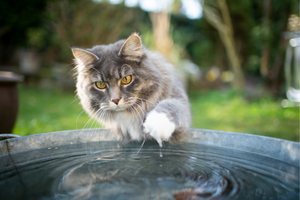
Plenty of cats that hate being wet love playing with water. You might see your cat:
- Drinking from a dripping or running tap.
- Patting the water in its bowl before drinking, or fishing out bits of food.
- Watching the shower or a filling bath.
- Sitting in the empty, damp shower recess or basin.
Moving water catches a cat's eye because it moves, sparkles and makes sounds, much like prey. Many cats also prefer running water for drinking. In the wild, flowing water is fresher and safer than still water. Some cats pat their bowl because they can't judge the water level well, or because their whiskers brush the sides of a narrow bowl.
If your cat seems to drink very little, a wide, shallow bowl or a cat water fountain can help. Our article on why cats don't drink much water explains how to keep your cat hydrated.
The cats that like water
Not every cat avoids water. Some breeds are well known for enjoying it:
- Turkish Van. Sometimes called "the swimming cat", it has a soft, water-resistant coat and a reputation for paddling in streams and pools.
- Maine Coon. Its shaggy, water-resistant coat suits wet, cold weather, and many Maine Coons love playing in water bowls, taps and showers. Our Maine Coon breed guide has more on their personality.
- Bengal. Active and curious, many Bengals are fascinated by water and some will happily get in.
- Norwegian Forest Cat. Its thick, oily topcoat sheds water well.
- Abyssinian, Savannah and Japanese Bobtail cats are also often described as being curious about water.
Some wild cats are strong swimmers. Tigers and jaguars swim readily, and the fishing cat of South and South-East Asia hunts in water.
Individual personality matters as much as breed. Some moggies love water, and some Turkish Vans don't.
Can cats swim?
Most cats can swim if they have to. They paddle instinctively and keep their heads up. But they tire quickly, and they don't always know how to get out.
In Australia, backyard swimming pools are a real risk. A cat that falls into a pool may not find the steps, and smooth tiled edges are hard to climb. If your cat has access to a pool area, a floating escape ramp gives it a way out. Better still, keep the cat out of the pool area altogether. A contained cat in a catio or indoors avoids the risk entirely.
Ponds, water tanks and buckets can also be dangerous for kittens. Cover water tanks and keep buckets empty or out of reach.
Advertisement
Do cats need baths?
Most cats don't. A healthy cat keeps itself clean by grooming, and regular brushing removes loose fur and dirt. Too much bathing can dry out the skin and coat.
There are exceptions where a bath is needed:
- Hairless cats. Sphynx and other hairless cats need baths every week or two, because their skin oil has no fur to absorb it. Our article on why hairless cats need baths explains why.
- Cats that can't groom well. Older, overweight or arthritic cats often can't reach their back or rear end, and their coat gets greasy, matted or soiled.
- Something on the coat. Paint, oil, sticky substances and anything that could be toxic if licked need washing off. If you're not sure whether something is toxic, call your vet first.
- Skin conditions. Your vet may prescribe medicated shampoo for some skin problems, ringworm or a severe flea infestation.
- Long-haired cats. Persians and other long-haired breeds sometimes need a bath to manage a greasy coat, usually alongside regular brushing.
A word of warning about flea products: never use a dog flea shampoo or treatment on a cat. Products for dogs can contain permethrin, which is highly toxic to cats and can be fatal. Use only products made for cats, and see our guide to flea treatment for cats in Australia.
How to bathe a cat with less stress
If your cat does need a bath, preparation makes all the difference. Have everything ready before you bring the cat in.
Before the bath
- Trim your cat's nails a day or two beforehand.
- Brush the coat to remove tangles and loose fur, which hold water.
- Gather supplies: cat shampoo (never human shampoo, which is the wrong pH), two or three towels, a jug or a gentle handheld shower, a non-slip mat, and treats.
- Choose the room. A laundry tub or the kitchen sink is easier on your back and less frightening for a cat than a full-sized bath. Close the door.
- Warm the room if it's a cool day.
During the bath
- Use only a few centimetres of water, at about body temperature. It should feel just warm on the inside of your wrist.
- Put the non-slip mat down so your cat can grip.
- Hold your cat gently but securely, with a hand under the chest. A second person helps.
- Wet the body with a jug or a low, gentle spray, working from the neck back. Keep water out of the eyes, ears and nose.
- Wash the face with a damp cloth only.
- Lather, then rinse thoroughly. Leftover shampoo irritates the skin, and your cat will lick it off.
- Talk quietly and work calmly and quickly. A bath should take a few minutes, not half an hour.
After the bath
- Wrap your cat in a towel and gently squeeze out as much water as you can. Swap to a dry towel when the first one is wet.
- Keep your cat in a warm, draught-free room until it's completely dry.
- Use a hair dryer only if your cat accepts it, on low heat and low speed, held well away from the skin. Many cats are frightened by the noise.
- Give treats and let your cat groom in peace. Expect a lot of grooming for the next hour or two.
If your cat becomes extremely distressed, stop. Forcing a bath risks injury to both of you and makes the next one harder. A professional cat groomer or your vet clinic can bathe a difficult cat, and some cats are better bathed under mild sedation from the vet.
Alternatives to a full bath
For a cat that hates baths but needs a clean-up, try:
- Spot cleaning a dirty patch with a damp, warm cloth.
- Pet-safe grooming wipes for small areas.
- Waterless cat shampoo or cleaning foam, worked into the coat and brushed out.
- Regular brushing, which prevents many of the problems that lead to baths.
- A hygiene clip around the rear end for long-haired cats that get soiled.
Don't use water as punishment
Spraying a cat with a water bottle to stop unwanted behaviour is common advice, but it doesn't work well. Cats don't connect the spray with what they were doing. They connect it with you. It can make a cat anxious and wary of the person holding the bottle, and the behaviour usually carries on when you're not there.
It works better to give the cat something else to do. Provide a scratching post next to the couch it's scratching, a high perch near the bench it jumps on, and plenty of play. Our article on things cats hate the most covers other common stresses for cats.
Frequently asked questions
Why do cats hate water but like taps?
Cats dislike getting soaked, which makes them heavy, cold and smelling wrong, especially when they're held in it. A dripping tap is different: the cat chooses to touch it, it can leave whenever it likes, and moving water is interesting to watch and fresh to drink.
Do all cats hate water?
No. Many cats dislike being wet, but breeds like the Turkish Van, Maine Coon and Bengal often enjoy water, and individual cats of any breed can love it.
Is it cruel to bathe a cat?
Not when a bath is needed and it's done calmly, quickly, with warm water and cat shampoo. Bathing a healthy cat often for no reason isn't necessary and can dry out its skin.
How often should I bathe my cat?
Most healthy cats with fur never need a bath, or only occasionally. Hairless cats need one every week or two. Older cats that can't groom well may need a bath now and then.
Can I use baby shampoo on my cat?
It's better to use a shampoo made for cats. Human shampoos, including baby shampoo, are made for human skin, which has a different pH from cats' skin.
What should I do if my cat falls into a pool?
Get it out, dry it gently, and keep it warm. If your cat coughs, breathes with difficulty, seems weak or swallowed a lot of water, see a vet promptly, even if it seems to recover.
Advertisement