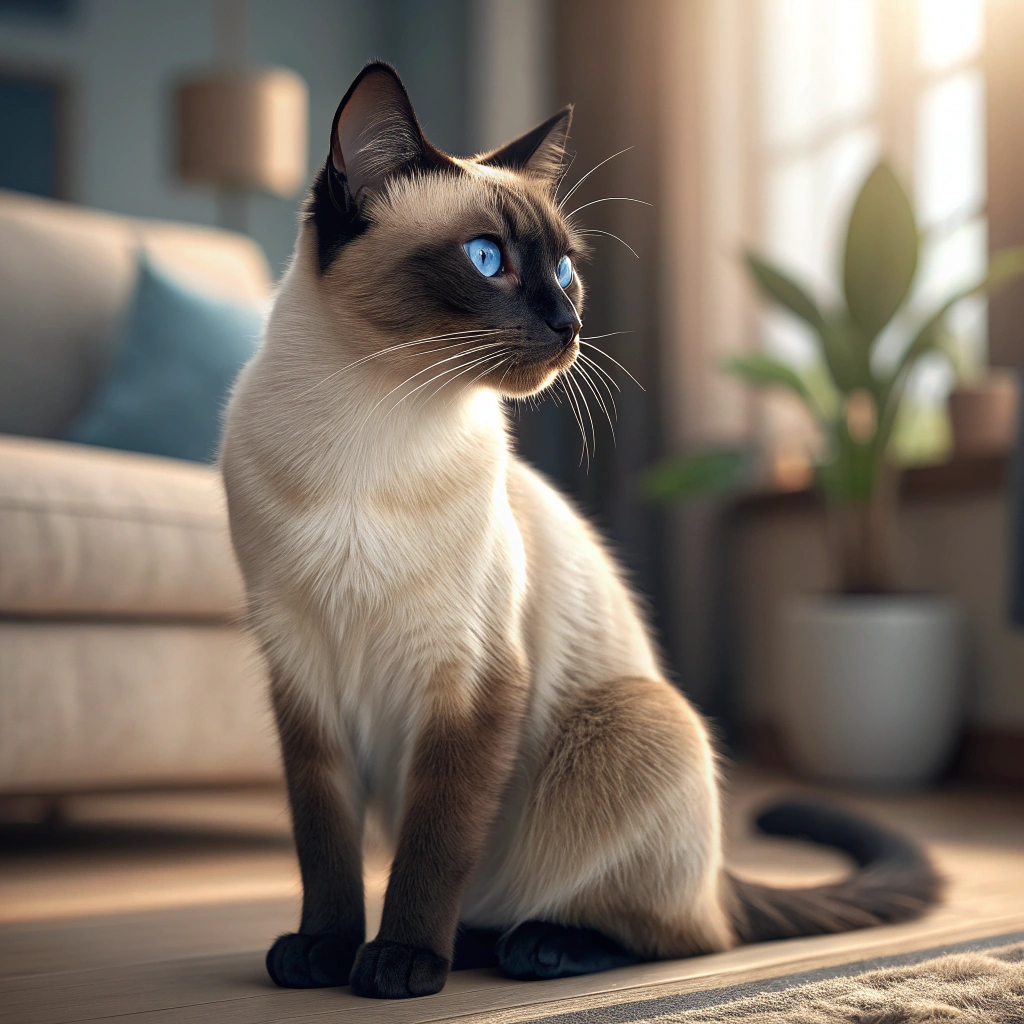
Siamese cats are vocal, clever and devoted to their people. Here's where the breed came from, the difference between modern and traditional Siamese, how the point colours work, the breeds descended from it, the health problems to know about, and how to care for one.
Few cats are as easy to recognise as a Siamese. The pale body, dark face, ears, legs and tail, and bright blue eyes have made it one of the best-known breeds in the world. Owners tend to talk about personality first, though. Siamese are famous for being talkative, clever, demanding and very attached to their people.
Advertisement
This guide covers where the breed came from, the different types of Siamese, how their colouring works, the breeds that descend from them, their personality, the health problems to know about, and how to care for one.
Where the Siamese came from
Siam
The Siamese comes from Siam, the country now called Thailand. Pointed cats appear in the Tamra Maew, or "Cat-Book Poems", a collection of Thai manuscripts describing different types of cats. The manuscripts are thought to date from the Ayutthaya period, which ran from 1351 to 1767, though the surviving copies are later. Among the cats they describe is one with a pale body and a dark face, ears, tail and feet, much like a Siamese.
Britain
Pointed cats from Siam began to reach the West in the late 1800s. In 1884 Edward Blencowe Gould, the British consul-general in Bangkok, brought a breeding pair called Pho and Mia home to Britain. Their kittens were shown at the Crystal Palace cat show in London in 1885. More imports followed, and the Siamese Cat Club was founded in Britain in 1901.
The United States
The first documented Siamese in the United States was a cat called Siam, sent from Bangkok in 1878 to the household of President Rutherford B. Hayes.
Kinks and crossed eyes
Many early Siamese had kinked tails and crossed eyes. Both were common in the foundation cats. Breeders selected against them, and kinked tails were largely bred out by about the 1950s. Crossed eyes are linked to the way the Siamese colour gene affects the wiring of the visual pathways, and selective breeding has made them much less common. You may still see an occasional cross-eyed Siamese, and the trait rarely affects a cat's quality of life.
Modern and traditional Siamese
Modern Siamese
From the 1950s and 1960s, show breeders increasingly favoured a long, slender cat with a wedge-shaped head, large ears, a long neck and fine legs. By the mid-1980s, the more rounded traditional type had largely disappeared from the show ring. The modern Siamese is the type you'll see at most cat shows today, including in Australia.
Traditional Siamese and the Thai
Some breeders kept breeding the older, more moderate type, with a rounder head and a sturdier body, often called the "apple-head" or "old-style" Siamese. From the 1980s, some cat registries recognised this type as a separate breed called the Thai. The Thai is now recognised by registries including The International Cat Association and the World Cat Federation.
Both types share the pointed colouring, blue eyes and Siamese personality. The difference is in body and head shape.
Colours and how they develop
The four classic colours
The Cat Fanciers' Association in the United States recognises four Siamese point colours:
- Seal point. Very dark brown points on a pale fawn to cream body. This is the classic Siamese look.
- Chocolate point. Warm milk-chocolate points on an ivory body.
- Blue point. Grey-blue points on a cool, bluish-white body.
- Lilac point. Pale, pinkish-grey points on a glacial white body.
Other registries recognise more colours, such as red, cream and cinnamon points, along with tabby (or lynx) and tortie points. The Cat Fanciers' Association registers cats in those extra colours as a separate breed, the Colorpoint Shorthair.
Why Siamese are pointed
The Siamese look comes from a variant of the gene for tyrosinase, the enzyme that makes pigment. The Siamese variant is temperature sensitive. It works poorly at normal body temperature but better in cooler parts of the body, so pigment forms mainly on the face, ears, legs and tail. This pattern is called acromelanism.
That has some practical effects:
- Kittens are born white. They develop in the warmth of the womb, so their points only start to show after birth and darken over the following weeks and months.
- Coats darken with age. Many Siamese gradually get darker on the body as they get older.
- Temperature matters. Cats living in colder conditions often have darker coats. A patch of fur that grows back after being shaved, for example after surgery, may come back darker for a while because the shaved skin was cooler.
Burmese colouring is caused by a different variant of the same gene. A cat with one Siamese copy and one Burmese copy has the in-between "mink" colouring of the Tonkinese. See our guide to Burmese cats in Australia.
Is there a black Siamese?
No. A solid black cat isn't pointed, so it can't be a Siamese under any registry's standard. A black cat with a Siamese body shape is an Oriental Shorthair.
Breeds descended from the Siamese
The Siamese has played a part in many other breeds:
- Balinese. A longhaired Siamese.
- Oriental Shorthair and Oriental Longhair. Siamese type in solid, tabby and other non-pointed colours, usually with green eyes.
- Himalayan (Colourpoint Persian). Developed by crossing Persians with Siamese to get Persian type with pointed colouring.
- Tonkinese. Originally from Siamese and Burmese crosses.
- Snowshoe. Developed in the 1960s from Siamese and bicolour American Shorthair cats, with white feet.
- Havana Brown. Developed from chocolate-point Siamese and black cats.
Ragdolls and Birmans also have pointed coats, but they are separate breeds with their own history. See our guide to Ragdoll cats and our overview of common cat breeds in Australia.
Personality
People who live with Siamese describe them in strikingly similar terms:
- Talkative. Siamese are one of the most vocal breeds. They have loud, distinctive voices and use them to comment on everything, from dinner being late to a closed door. If you want a quiet cat, a Siamese probably isn't for you.
- Social and people-focused. Most Siamese want to be with their people and involved in whatever they're doing. Many bond especially closely with one person.
- Intelligent and active. They learn quickly, enjoy puzzle feeders and games, and many learn to fetch or walk on a harness. They also learn how to open cupboards.
- Demanding. A bored Siamese finds its own entertainment, which may not be what you had in mind.
Siamese don't like being alone
A Siamese left alone for long hours every day is likely to be unhappy and may develop problem behaviours, including excessive vocalising. If everyone in your home works full time, consider two cats, or a different breed. Siamese often do well with another active, sociable cat for company.
Talking back
If you want to reduce excessive meowing, the key is not to reward it. Make sure your cat's needs are met with regular meals, play and attention on a predictable routine, and give attention when the cat is quiet rather than when it's yelling. Our guide to how to stop your cat from meowing has more detail. A sudden change in how much an older cat vocalises can be a sign of illness, so mention it to your vet.
Health
Advertisement
Siamese are generally long-lived cats, but the breed has some inherited and breed-associated conditions. A responsible breeder knows about them and tests for the ones that can be tested.
Progressive retinal atrophy
Progressive retinal atrophy (PRA) is an inherited disease in which the cells of the retina gradually degenerate, leading to blindness. A form caused by a mutation in the CEP290 gene is common in the Siamese breed group, including Orientals, Balinese and related breeds. It's recessive, so a cat needs two copies to be affected, and a DNA test lets breeders avoid mating two carriers. Ask whether your kitten's parents have been tested.
GM1 gangliosidosis
GM1 gangliosidosis is a rare, fatal inherited disease of the nervous system. Affected kittens develop tremors and poor coordination at a few months of age. It's recessive, caused by a mutation in the GLB1 gene, and a DNA test is available.
Lymphoma
Siamese and Oriental cats are over-represented among cats with lymphoma, a cancer of the immune cells. An Australian study of cats with lymphoma found Siamese over-represented compared with crossbred cats, and particularly prominent among young cats with lymphoma in the chest (mediastinal lymphoma). Unlike lymphoma in many other cats, the disease in young Siamese and Orientals in Australia was usually not linked to the feline leukaemia virus, which suggests a genetic cause.
See your vet if your cat has trouble breathing, coughs, loses weight or loses its appetite. Lymphoma can often be treated, especially when it's caught early.
Other conditions to know about
- Wool sucking and pica. Siamese and other Oriental breeds are prone to sucking or chewing wool and fabric, and sometimes swallowing it. Swallowed fabric can cause a blockage that needs surgery. If your cat chews fabric, talk to your vet. Puzzle feeders, extra play, and keeping tempting items out of reach can help.
- Dental disease. Like any cat, a Siamese needs regular dental checks, and tooth brushing if the cat will accept it.
- Asthma and other conditions. Siamese are often listed as prone to asthma, and to some other conditions such as amyloidosis, a disease in which abnormal protein builds up in organs such as the liver. Evidence on how common these are in Australian Siamese is limited, but they're worth knowing about.
Lifespan
Siamese have a reputation for long lives. In a large study of cats seen at veterinary practices in England, published in 2015, Siamese had a median age at death of 14.2 years. That was similar to the 14.0-year median for all cats in the study, and Siamese were among the longest-lived breeds. The number of Siamese in the study was small, but many Siamese live well into their late teens.
Caring for a Siamese
Grooming
The Siamese coat is short, fine and close-lying, with very little undercoat, so it needs very little grooming. A weekly rub with a rubber grooming mitt or soft brush removes loose hair. Trim claws as needed, check ears and look after teeth.
No cat breed is hypoallergenic. Siamese shed less visible hair than longhaired cats, but they still produce the allergens that affect people with cat allergies.
Food and weight
Feed a complete and balanced diet in measured amounts. Siamese are usually slim, active cats, and you should be able to feel the ribs easily. A Siamese that gets heavy needs its portions checked. See our guide to how often to feed your cat.
Play and enrichment
A Siamese needs daily play and mental exercise. Wand toys, fetch games, puzzle feeders, clicker training and climbing spaces all help. See our guides to interactive cat toys, cat scratching posts and cat trees, and cat harnesses.
Keep them safe
Siamese are curious and confident, which makes them vulnerable to cars, dogs and getting lost outdoors. Keep your Siamese indoors with access to a secure enclosure if you can. Many Australian councils now have cat curfews or containment rules. See our guides to cat laws in Australia and cat enclosures and catios.
Their short, fine coat has little undercoat, so give your Siamese warm, soft beds in winter. See our guide to cat beds.
Getting a Siamese
Registered breeders
The safest source of a Siamese kitten is a breeder registered with a recognised cat council. Ask:
- Have the parents been DNA tested for PRA (CEP290) and GM1 gangliosidosis?
- Can I meet the mother, and see where the kittens are raised?
- How are the kittens socialised?
- What vaccinations, worming and flea treatment will the kitten have had?
- Will the kitten be microchipped and desexed before it goes home?
- Will you take the cat back if I can't keep it?
Registered breeders usually keep kittens until about 12 weeks or older. Be cautious of very cheap kittens, sellers without papers or registration, and anyone who won't let you meet the kitten. Our guide to Siamese kittens for sale in Australia has more on finding a breeder.
Adoption
Siamese and Siamese crosses sometimes come up for adoption through shelters and breed rescue groups. Many "Siamese" cats in shelters are pointed crossbreds, which can have plenty of Siamese personality. Our guide to kittens for adoption in Melbourne lists shelters and rescue groups.
Frequently asked questions
Are Siamese cats good for first-time owners?
They can be, if you want an interactive cat and have time to give it. A Siamese needs company, play and attention every day. If you'd prefer a quieter, more independent cat, another breed may suit you better.
Do Siamese cats meow a lot?
Yes. They're one of the most vocal breeds, with loud voices. Most owners see it as part of the charm, but it's worth meeting adult Siamese before you commit.
Why do Siamese cats get darker?
Their colour gene works better in cooler parts of the body, so the points darken first. Many Siamese also get gradually darker on the body with age, and cats in colder conditions are often darker.
Are Siamese cats affectionate?
Very. Most Siamese are devoted to their people and want to be close to them. Many bond most strongly with one person.
How long do Siamese cats live?
In a large English study of cats at veterinary practices, the median age at death for Siamese was 14.2 years. Many live longer.
What's the difference between a Siamese and a Thai?
The Thai is the older, more moderate type of Siamese, with a rounder head and sturdier body. Some registries treat it as a separate breed. The modern Siamese is longer and slimmer, with a wedge-shaped head and large ears.
Are Siamese cats good with other pets?
Most get along well with other cats and cat-friendly dogs when introduced slowly, and many enjoy the company. An active, sociable companion cat is often a good match.
Advertisement