The Maine Coon is one of the most searched cat breeds online and for good reason. Its towering frame, flowing coat, and calm temperament make it unlike almost any other domestic cat. But is it truly the largest domestic cat breed? The answer, as you’ll discover, is both fascinating and more nuanced than most sources let on.
Maine Coon’s Reputation
The Maine Coon has long occupied a distinguished position among domestic cats. Its formidable size, coupled with a dignified bearing, has earned it a reputation that borders on legendary. Admirers often speak of this breed in superlatives imposing, majestic, and undeniably captivating. Search “largest domestic cat breed” anywhere online and the Maine Coon’s name appears almost without exception. That kind of consistent recognition doesn’t happen by accident.
Yet reputation alone does not establish fact. While the Maine Coon is frequently labeled the largest domestic cat breed, the reality is more nuanced. Careful examination reveals a blend of measurable traits, genetic influences, and selective perception. Understanding what truly makes this breed so large and where it sits relative to its rivals requires looking beyond surface-level claims.
Why the Maine Coon Draws Attention as a Giant Among Domestic Cats
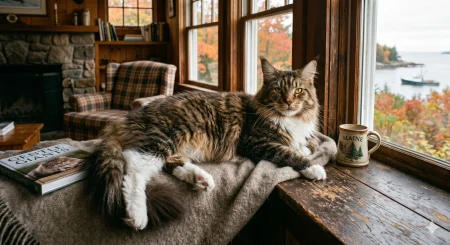
Few domestic cats possess the same visual gravitas as a fully grown Maine Coon. It commands attention without effort. Its elongated body, tufted ears, broad chest, and expansive, plume-like tail create an impression of scale that is genuinely difficult to overlook. Photographs rarely do it justice. Seeing one in person, stretched across a sofa or perched regally on a cat tree, is a different experience entirely.
Observers are often struck first by length rather than weight and this distinction matters enormously. A Maine Coon may not always be the heaviest cat in a room, yet it frequently appears the largest due to its extended frame and luxuriant, semi-long coat that adds visual bulk in every direction. The fur around the neck forms a natural ruff, the tail fans outward dramatically, and the tufted paws and ear tips add to the overall sense of mass.
Its presence is not merely physical, either. There is a certain composure an almost aristocratic calm that amplifies its perceived size. Maine Coons carry themselves with an unhurried confidence that makes them seem larger still, as though they are fully aware of the impression they make and have long since made peace with it.
Common Misconceptions About Cat Size and Breed Rankings
A common error is equating size solely with weight. Many people assume the heaviest cat must also be the largest. This is misleading at best and genuinely confusing when comparing breeds. Length, height, and structural build all contribute meaningfully to overall size, and no single measurement tells the complete story.
Another misconception lies in overgeneralizing from exceptional cases. Not every Maine Coon reaches extraordinary proportions. Breed standards provide averages, not guarantees. Record-breaking specimens make headlines, but they represent the extreme upper end of a broad distribution. Expecting your Maine Coon kitten to grow into a world-record contender is like expecting every human child to become a professional basketball player possible, but far from typical.
It’s also worth noting that “largest” means different things in different contexts. A cat can be the longest, the tallest, or the heaviest, and these categories don’t always belong to the same breed. Keeping these distinctions in mind is essential for an honest answer.
What Defines the Largest Domestic Cat Breed?
Determining the largest domestic cat breed requires more than casual observation or a quick glance at popular rankings. It demands precise metrics, consistent criteria, and a willingness to acknowledge that “largest” is a multidimensional concept.
Key Measurements: Weight, Length, and Overall Build
Weight is the most frequently cited measurement and the easiest to quantify. However, it tells only part of the story. A cat that weighs more may simply carry more fat, which is not the same as being structurally larger. Weight must be considered alongside body composition is that mass muscle, bone, or excess fat?
Length measured from the tip of the nose to the end of the tail is equally significant and often more telling. Some cats are long but lean, presenting an impressive silhouette without much mass behind it. Others are compact yet heavy, dense with muscle and broad-boned. Both are “large,” but in completely different ways.
Overall build introduces further complexity still. Bone density, musculature, chest width, and body composition all influence how size is perceived and experienced. A robust, barrel-chested cat may appear to dominate a space even when its raw measurements are comparable to a slenderer cat of the same length. This is why the Maine Coon so often wins the perception battle it has both length *and* a substantial, well-muscled frame beneath all that fur.
Difference Between Tall, Long, and Heavy in Feline Terms
These distinctions are subtle but essential to understanding breed comparisons accurately.
– Tall refers to leg length and shoulder height. A tall cat has longer limbs, giving it greater elevation off the ground. The Savannah cat, for instance, is notably tall relative to its body weight.
– Long refers to an extended torso and tail. Length is the Maine Coon’s greatest strength. Many individuals exceed one meter from nose to tail, which is genuinely remarkable for a domestic cat.
– Heavy refers to mass, which can result from muscle, bone density, or fat. The Ragdoll breed often wins on weight without necessarily matching the Maine Coon in length.
The Maine Coon excels primarily in length and overall structural presence. This characteristic is central to its reputation and is what most people respond to when they describe the breed as “enormous.”
Maine Coon Size Profile Explained
Understanding the Maine Coon’s dimensions requires examining typical ranges rather than isolated extremes or record-breaking outliers. Context matters enormously here.
Average Weight Range for Male and Female Maine Coons
Male Maine Coons typically weigh between 6 to 8 kilograms (13–18 lbs) . Well-fed, well-bred males from strong lineages can occasionally exceed this range, reaching 9 or even 10 kilograms in exceptional cases. Females are generally smaller, ranging from 4 to 6 kilograms (9–13 lbs) , though they too can surpass these averages depending on genetics and diet. These figures firmly place the breed among the heavier domestic cats, though not always at the absolute top of every ranking.
The sexual dimorphism in Maine Coons the size difference between males and females is notably more pronounced than in many other breeds. This means prospective owners looking for maximum size are often specifically seeking male cats, while those who want a large cat but in a more manageable package may find females a better fit.
Length From Nose to Tail and What Makes It Impressive
Length is where the Maine Coon genuinely distinguishes itself from most other domestic breeds. Many individuals comfortably exceed one meter (roughly 40 inches) from nose to tail , with some exceptional specimens reaching 120 cm or more. For context, the average domestic cat measures around 46 cm in body length, making a 100+ cm Maine Coon an extraordinary sight even to experienced cat owners.
This elongated silhouette is further accentuated by the breed’s full, plume-like tail, which can itself measure 35 to 40 cm. The tail is not merely decorative it functions as a balance mechanism and a behavioral communication tool, and in the Maine Coon, it adds dramatically to the overall impression of scale. When a Maine Coon wraps that tail around its body or sweeps it through the air, the effect is genuinely theatrical.
Growth Timeline and When Maine Coons Reach Full Size
Unlike many breeds that reach physical maturity within the first year, Maine Coons are famously slow developers. Full growth may take three to five years a timeline that surprises many first-time owners who expect their kitten to plateau far sooner. A two-year-old Maine Coon may still be adding muscle mass and body length well into its third year.
This extended development period is one reason Maine Coons achieve such impressive final sizes. Rather than a rapid early growth spurt followed by early plateau, they experience a long, gradual expansion in both size and musculature. The result is a cat that fills out rather than shoots up gaining substance and depth over time in addition to raw length and weight. Patience is genuinely rewarded with this breed.
How the Maine Coon Compares to Other Large Breeds
The Maine Coon does not exist in isolation. Several breeds rival or in some cases exceed it in specific size categories, each with their own distinct characteristics and heritage.
Norwegian Forest Cat vs Maine Coon
The Norwegian Forest Cat is perhaps the Maine Coon’s closest rival in both size and appearance. Sharing a heritage adapted to cold, harsh climates, both breeds developed thick, water-resistant coats, large frames, and robust constitutions. The Norwegian Forest Cat is sturdy, well-muscled, and similarly adapted to demanding environments there is even a longstanding theory that the two breeds may share common ancestry via Viking-era cats.
In direct comparison, the Norwegian Forest Cat often appears more compact and rounded than the Maine Coon. It carries comparable weight but tends to lack the same extreme length. Its coat is also slightly different in texture denser and more uniformly long rather than the Maine Coon’s shaggy, uneven layering. Both breeds are exceptional; which appears larger often depends on individual variation and viewing angle.
Ragdoll Cats: Weight vs. Length
The Ragdoll is a serious contender for the title of heaviest domestic cat breed. Some individual Ragdolls surpass Maine Coons in raw mass, with large males occasionally exceeding 9 to 10 kilograms. This is largely due to the Ragdoll’s broad, heavy-boned build and tendency to accumulate more body mass per unit of length.
However, Ragdolls typically lack the Maine Coon’s extraordinary length. The result is a cat that may weigh more but doesn’t *look* as large it appears dense and solid rather than elongated and imposing. In terms of pure visual impact and measured length, the Maine Coon generally retains the advantage, even when the scale tips in the Ragdoll’s favor.
Savannah Cats and the Role of Hybrid Genetics in Size
The Savannah cat introduces a unique and fascinating variable: hybrid genetics . Descended in part from African servals a medium-sized wild cat species Savannah cats, particularly earlier generations (F1 and F2), can be exceptionally tall and long. In certain cases, they surpass Maine Coons in both height and overall length, making them legitimate competitors for the “largest domestic cat” title depending on how you define domestic.
The key caveat is that early-generation Savannahs are not fully domestic in the traditional sense. Their wild heritage means they require more specialized care, often have different dietary needs, and may not be legal to own in all states, countries, or territories. Later-generation Savannahs (F4 and beyond) are smaller and more reliably domesticated, but they also lose much of the size advantage that makes earlier generations so impressive.
Factors That Influence a Maine Coon’s Size
Size is not predetermined by breed designation alone. Multiple interacting factors contribute to a cat’s ultimate dimensions, and understanding these can help owners provide the best possible conditions for healthy growth.
Genetics and Lineage: The Foundation of Growth Potential
Lineage plays the most decisive role of all. Cats bred from larger parents are significantly more likely to achieve greater size themselves not guaranteed, but strongly predisposed. Selective breeding practices over generations can amplify desirable size traits, which is why reputable breeders with documented lineage records often produce the most consistently large cats.
When purchasing or adopting a Maine Coon, asking about parental size is entirely reasonable. Meeting the parents in person, if possible, gives a reliable preview of likely adult dimensions. Cats from show-quality lines with large, well-documented ancestors tend to produce the most impressively sized offspring.
Diet and Nutrition: Building the Frame
Nutrition is fundamental to achieving a cat’s full genetic potential. A high-protein diet rich in quality animal-based ingredients supports healthy muscle development and sustained growth throughout the Maine Coon’s extended maturation period. Because they grow for up to five years, nutritional support must be maintained well beyond the kitten phase.
Conversely, poor nutrition particularly in the early years can permanently limit development regardless of genetic potential. Overfeeding to the point of obesity is equally problematic; excess fat does not translate to the healthy structural size that defines the breed. The goal is lean, well-muscled mass achieved through appropriate caloric intake and balanced macronutrients, ideally under veterinary guidance.
Environment, Exercise, and Overall Health
A stimulating, enriching environment encourages physical activity, which directly promotes healthy muscle development. Maine Coons are naturally active cats that enjoy climbing, exploring, and interactive play. Providing ample opportunity for movement tall cat trees, open spaces, regular play sessions supports the physical development appropriate to their size.
Regular veterinary care ensures that growth proceeds without impediment from illness, parasites, or nutritional deficiencies. Large breeds can be disproportionately affected by certain health issues when young, making routine check-ups particularly valuable during the growth years. A healthy cat grows more efficiently than one managing chronic or subclinical illness.
Notable Examples of Exceptionally Large Maine Coons
Several Maine Coons have achieved remarkable lengths and earned formal recognition in world records. Stewie , a male Maine Coon from Nevada, held the Guinness World Record for the longest domestic cat for several years, measuring an extraordinary 123.19 cm (48.5 inches) from nose to tail. Barivel, an Italian Maine Coon, later claimed the record at 120 cm. These cats exemplify the genuine upper limits of what the breed can achieve.
How Records Are Measured and Verified
Measurements are conducted with considerable precision and involve standardized procedures. Length is assessed from the tip of the nose to the very end of the tail, with the cat stretched to its natural extended length typically while lying flat. Verification involves multiple independent measurements, witnessed documentation, and adherence to strict Guinness guidelines to ensure accuracy and prevent exaggeration or error.
What These Extremes Mean for Average Pet Owners
These extraordinary cases are genuine outliers. They represent the far end of the breed’s size distribution and should not define expectations for typical ownership. Most Maine Coons, while undeniably large and impressive, fall comfortably within the established average ranges perhaps 80 to 100 cm in total length and 5 to 8 kilograms in weight. That is still remarkable by domestic cat standards; it simply doesn’t require a special freight arrangement to transport them to the vet.
Temperament Versus Size: The Gentle Giant in Practice
Physical size does not dictate behavior. This principle is particularly evident in the Maine Coon, where a substantial frame coexists with a remarkably gentle and sociable personality.
Why Large Size Does Not Mean Aggressive Behavior
A common concern among prospective owners especially those new to large breeds is whether a bigger cat might be more aggressive or difficult to manage. With Maine Coons, this concern is almost entirely unfounded. Size and temperament operate independently, and the Maine Coon’s personality is shaped by centuries of companionable coexistence with humans, not by its physical dimensions.
They are assertive in the sense of being confident and self-possessed, but assertiveness in a well-socialized Maine Coon rarely tips into aggression. Even when startled or mildly annoyed, most Maine Coons respond with a distinctive trill or chirp rather than a swipe or bite a charming quirk that owners consistently mention as one of the breed’s most endearing traits.
The Gentle Giant Personality of the Maine Coon
The breed is near-universally described as a gentle giant , and this reputation is well-earned. Maine Coons exhibit a calm, sociable disposition that adapts readily to different household environments. They are affectionate without being clingy present and engaged without demanding constant attention. Many follow their owners from room to room with the quiet loyalty of a dog, settling nearby rather than insisting on lap time.
They tend to remain playful well into adulthood, often retaining kitten-like curiosity and enthusiasm for interactive toys throughout their lives. This combination of large physical presence and gentle, good-natured personality is precisely what makes them so appealing to such a wide range of owners.
Suitability for Families and Multi-Pet Households
Their adaptable, sociable nature makes Maine Coons exceptionally well-suited to family environments. They typically coexist harmoniously with children, provided the children are taught appropriate interaction a consideration with any cat, regardless of breed. Their patience and measured temperament mean they handle the unpredictability of young children better than many other breeds.
They also integrate well into multi-pet households. With properly managed introductions, most Maine Coons develop amicable relationships with both other cats and dogs. Their confidence means they are rarely intimidated by other animals, and their sociable disposition means they often actively seek companionship rather than avoiding it.
Caring for a Large Breed Cat
Ownership of a large cat entails specific responsibilities that prospective owners should understand before bringing a Maine Coon home.
Space Requirements and Ideal Living Conditions
Adequate space is not a luxury for a Maine Coon it is a genuine need. These are active, curious cats that require room to move, explore, and engage with their environment. A small apartment is not automatically disqualifying, but it does require more deliberate effort to provide adequate enrichment through vertical space, interactive toys, and regular play sessions.
Tall, sturdy cat trees are particularly valuable and almost essential for this breed. Maine Coons love to climb and survey their territory from height, and a flimsy structure will not safely support their weight. Investing in quality, heavy-duty furniture designed for large cats pays dividends in both safety and daily enrichment.
Grooming Needs for a Long-Haired, Large Cat
Their dense, semi-long coat is one of the breed’s most striking features and one of its most demanding maintenance requirements. Regular grooming is not optional. Brushing two to three times per week (daily during heavy shedding periods) prevents matting, reduces hairballs, and keeps the coat in the healthy, lustrous condition that defines the breed’s appearance.
The fur around the mane, underbelly, and behind the ears is particularly prone to tangling and should receive extra attention. Starting grooming routines early in kittenhood helps cats accept the process as normal, making adult maintenance significantly easier. Professional grooming every few months can supplement home care, particularly for owners who find the task challenging.
Health Considerations Linked to Larger Body Size
Larger breeds may be predisposed to certain health conditions that owners should monitor proactively. Hypertrophic cardiomyopathy (HCM) a form of heart disease has a higher prevalence in Maine Coons than in many other breeds and can affect cats of any size, making cardiac screening particularly important. Hip dysplasia is another condition worth monitoring, as the breed’s size places additional mechanical stress on its joints over time.
Spinal muscular atrophy (SMA) is a genetic condition found in some Maine Coon lines; reputable breeders test for this and other heritable conditions. Regular veterinary check-ups, ideally with a vet experienced in large breeds, are strongly advisable throughout the cat’s life not just during kittenhood. Early detection makes an enormous difference in managing any health issue that arises.
So, Is the Maine Coon Truly the Largest Domestic Cat Breed?
The answer is nuanced and that nuance is itself illuminating.
The Maine Coon is undeniably one of the largest domestic cat breeds , particularly in terms of overall length and visual presence. It holds legitimate world records for individual cats and consistently ranks at or near the top of size comparisons across virtually every credible source. For most practical purposes, when someone asks “what is the largest domestic cat?”, the Maine Coon is the correct and defensible answer.
However, it does not hold an uncontested position in every measurable category. Some individual Ragdolls exceed it in weight. Some Savannah cats surpass it in height. The Norwegian Forest Cat rivals it closely in overall build. No single breed dominates every dimension simultaneously.
What the Maine Coon does better than any other breed is combine size with elegance, personality, and practical domesticity . It is large and beautiful, gentle and playful, sociable and independent. It holds world records without requiring specialized permits. It lives contentedly in family homes without demanding wild-cat-level care.
In that sense, the Maine Coon stands not merely as the largest domestic cat, but as the most compelling one an argument made not just in measurements, but in presence, character, and the particular, irreplaceable experience of sharing a home with an animal that seems to belong to a different, grander scale of existence.